

A USCIS request for evidence is a formal notice saying your filing does not yet contain enough proof for a decision. For many cases, the issue is not that your application is automatically failing, but that the record is incomplete, unclear, or inconsistent. Understanding what the notice actually asks for, and what the deadline really means, shapes the difference between a focused response and a preventable denial.
What a USCIS Request for Evidence Means
USCIS describes a Request for Evidence, or RFE, as a notice issued when additional documentation is needed to determine eligibility. The governing framework appears in the USCIS Policy Manual and in case processing guidance published by USCIS, which indicates that adjudicators may request missing initial evidence or additional evidence when the existing record does not establish eligibility (USCIS Policy Manual, 2026, USCIS).
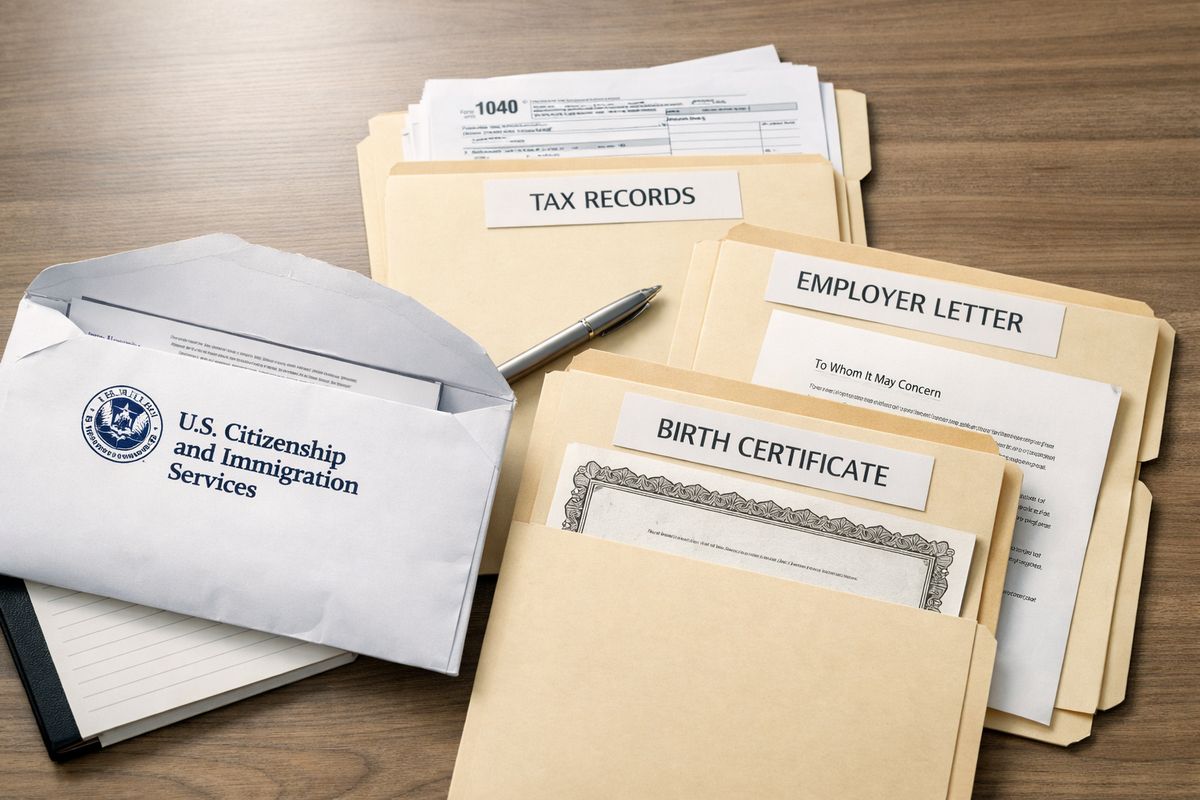
That distinction matters. Missing evidence means a required document was not included at all, such as a birth certificate, tax record, or employer letter. Insufficient evidence means documents were submitted, but not in a form strong enough to prove the point USCIS must decide. A likely denial is different again. In some cases, the problem is not just an absent document, but a legal or factual gap that may remain even after additional records are added.
The notice itself usually signals which category applies. If USCIS asks for a specific civil document, the problem may be narrow. If the notice questions whether your job qualifies, whether a marriage is bona fide, or whether status was maintained, the issue may be more substantive.
Finding: an RFE is a request to complete the record, not an automatic denial.
What the Deadline Really Requires
USCIS instructions indicate that response timing is controlled by the date printed on the notice, and the agency generally must receive the response by that deadline rather than simply see a postmark by that date (USCIS, 2026, filing guidance). That deadline is not a suggestion. If the response arrives late, USCIS may decide the case based only on what was already in the file, which can lead to denial.
The practical consequence is simple: count backward from the receipt deadline, not from the day you plan to mail the package. Shipping delays, rejected deliveries, missing signature pages, or address mistakes can turn a timely-prepared response into a late one.
There is a limitation here. Timing rules can differ depending on the wording of the notice, the filing channel, and the case posture. Some notices permit online upload, while others require physical delivery to a designated address. The notice controls.
Finding: your first task is to identify the exact receipt deadline on the notice and build backward from it.
How to Read the RFE Notice
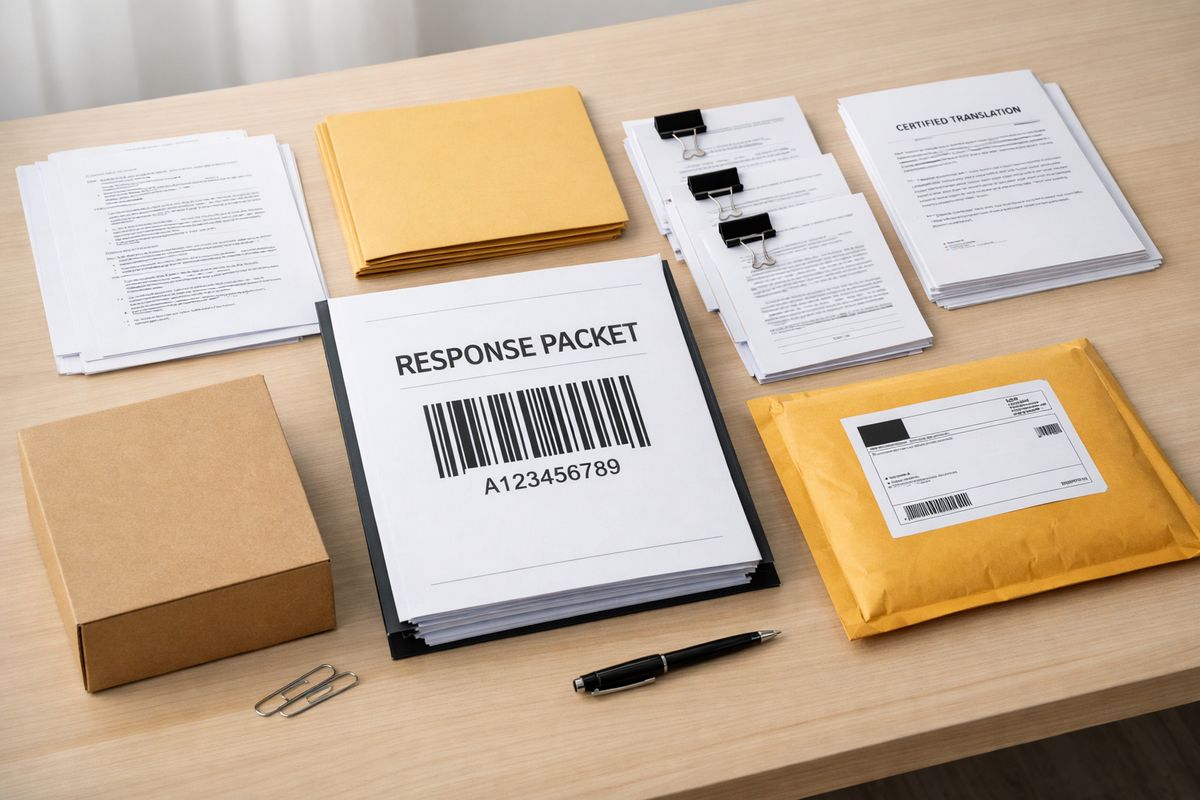
An RFE notice usually contains five parts that matter immediately: the form or case type, the evidence requested, any legal citations, the address or submission method, and document-handling instructions such as whether to provide copies or originals. USCIS may also include a barcode page that should be returned with the response because it helps route the package correctly.
The easiest way to read the notice is to separate each distinct request into its own item. A single paragraph may contain three separate deficiencies, for example a missing financial record, an unclear date discrepancy, and a missing translation certification. If you treat that paragraph as one task, something tends to get missed.
If your filing category is unfamiliar, context helps. A family petition may turn on proof discussed in a guide to who files a family petition and what it does. An employment filing may require status or employer records that overlap with staying compliant in intracompany transfer status. The point is not to guess. The point is to decode every request exactly as written.
Finding: the notice itself defines the scope of the response.
Why You Should Not Wait Until the Final Week
A short response window becomes even shorter once you factor in document collection. Certified translations take time. Government corrections take time. Employers may need days to prepare support letters or payroll records. Medical or licensing documents may require appointments, requests, or follow-up.
Delay also increases the chance of inconsistencies. Last-minute submissions often include mixed date formats, incomplete exhibits, or records that were never cross-checked against the original filing. Those errors create new issues while trying to fix old ones.
There is one limitation. A narrow RFE can sometimes be answered quickly if the requested evidence already exists and does not require explanation. But that is the exception, not the planning rule.
Finding: the strongest responses usually come from early issue-spotting, not last-minute assembly.
The Most Common Reasons USCIS Issues an RFE
USCIS form instructions, the USCIS Policy Manual, and adjudication trends reflected in published guidance point to recurring patterns: missing required initial evidence, unclear eligibility, inconsistent facts, weak proof of relationship or status maintenance, and form defects such as missing signatures or outdated editions (USCIS Forms, 2026, form instructions and checklists).
In plain terms, USCIS asks for more when the file does not clearly prove each legal element of the benefit requested. Sometimes the problem is administrative. Sometimes it goes to the heart of eligibility.
Finding: most RFEs arise from record gaps, contradictions, or missing required proof.
Missing Required Initial Evidence
Initial evidence is the baseline documentation a form requires at the time of filing. Depending on case type, that can include identity documents, civil certificates, tax records, maintenance-of-status records, labor documentation, or employer support materials. USCIS publishes form-specific instructions that identify much of this required evidence up front (USCIS Form Instructions, 2026).
If those baseline documents are absent, adjudication often cannot move to the deeper merits analysis. For employment-based cases, that may involve labor certification or sponsorship records, especially in filings connected to the permanent labor stage for EB-3 sponsorship or how the employment-based green card process unfolds. For investor or extraordinary ability filings, the missing item may relate to proof categories discussed in what evidence tends to matter in O-1 filings.
Finding: if required baseline documents are absent, USCIS often issues an RFE before it evaluates the merits in full.
Inconsistencies, Gaps, and Unclear Facts
An application can trigger an RFE even when the document stack is large. If job titles differ across letters, if addresses do not match prior filings, or if entry dates conflict with government records, USCIS may question whether the facts are reliable enough to establish eligibility.
Minor discrepancies do not always matter. But if the difference affects maintenance of status, relationship validity, work history, or period of residence, clarification becomes necessary. In practice, inconsistency can weaken otherwise good evidence because the adjudicator has to decide which version of the facts is accurate.
Finding: inconsistency can matter as much as missing evidence.
Case-Specific Triggers by Filing Category
RFE triggers usually track the legal elements of the filing type. In family-based cases, USCIS often focuses on the qualifying relationship, joint records, or affidavit of support issues. In employment-based cases, common questions involve specialty occupation, beneficiary qualifications, employer need, or status maintenance. In adjustment cases, missing medicals, financial sponsorship issues, or travel and status history can become central.
That pattern is useful because it helps you read the notice in context. If the filing involves extraordinary ability, investor status, or adjustment from a nonimmigrant category, the RFE usually targets the exact element USCIS believes remains unproven.
Finding: the evidence USCIS questions usually tracks the legal elements of your case category.
What to Do Before the Deadline
An effective response starts with a line-by-line reading of the notice, followed by a document plan, a fact check, a response index, and a delivery review. The objective is not to overwhelm USCIS with paper. The objective is to answer every question directly and in a format that can be reviewed quickly. A more detailed breakdown of response structure appears in a step-by-step guide to answering an evidence request without creating new issues.
Finding: an effective RFE response is a structured package that answers every question in the notice directly.
Make a Document List Tied to Each Request
Convert the notice into a checklist. If the RFE identifies four separate deficiencies, your response should contain four corresponding sections, each with the specific document or explanation that addresses that item.
Grouping by issue works better than grouping by source. For example, placing a tax return, employer letter, and payroll record together under one disputed employment issue is usually clearer than separating all tax records into one section and all letters into another.
Finding: a point-by-point checklist reduces the risk of partial responses.
Gather Stronger Evidence, Not Just More Paper
USCIS evaluates relevance and credibility, not bulk. Primary records usually carry more weight than informal statements. Certified records, complete translations, consistent dates, and third-party documentation are stronger than unsupported assertions.
There is a limitation. Sometimes direct records do not exist, especially in older civil-document cases or unusual factual circumstances. In those situations, affidavits and secondary evidence may be necessary. But affidavits usually work better when paired with objective proof, such as government correspondence, archive searches, or records showing attempts to obtain the missing document.
Finding: targeted, credible evidence carries more weight than a large but unfocused submission.
Prepare a Clear Cover Letter or Response Index
A response letter should restate each RFE item and identify the exhibit that answers it. Clarity matters more than advocacy language. If the RFE says the marriage evidence is insufficient, the letter should identify the exact joint documents provided and explain what period each one covers. If the issue is status maintenance, the letter should map the timeline to the records.
Tabs, exhibit labels, and page numbers help. So does a simple order that follows the notice item by item.
Finding: organization helps USCIS see that each request has been answered.
Check Filing Logistics Before Sending Anything
Before sending the package, confirm the address, the required notice pages, the barcode sheet, the packaging method, and the delivery service. Keep a complete copy of everything submitted and use tracking that confirms delivery.
Procedural errors can affect good cases. A response sent to the wrong address, or without the notice pages that route it, may not reach the correct file in time. Timing expectations after delivery may also vary, which is why broader context on current government case timing patterns can be useful, though an individual RFE review will not follow a fixed published schedule.
Finding: procedural mistakes can undermine a substantively strong response.
Mistakes That Can Hurt an RFE Response
Practitioner guidance and USCIS instructions repeatedly point to the same avoidable errors: incomplete responses, irrelevant evidence, missing translations, missing signatures, and unresolved contradictions with prior filings. Those mistakes matter because USCIS decides the case on the record in front of it, not on what you intended to provide.
Finding: incomplete or inconsistent responses create denial risk even when the missing evidence exists.
Responding to Only One Issue
An RFE may contain multiple independent problems. Fixing the easiest one does not cure the others. If USCIS requests one complete response, the package should address every listed deficiency at the same time.
A partial response can leave the case legally unresolved even if one item is well documented.
Finding: USCIS usually evaluates the response against the full notice, not against one corrected item.
Sending New Problems with the Old Ones
Corrected documents can create new contradictions. A revised employer letter may conflict with a prior filing date. An amended personal statement may change the timeline without explaining why. If the new evidence changes the factual record, the response should reconcile the difference directly.
Silence is rarely enough. If a prior filing contained an error, say so clearly and support the correction.
Finding: when evidence changes the factual record, the explanation matters as much as the document.
Assuming an RFE Is Routine in Every Case
Some RFEs are narrow document requests. Some are signs of deeper eligibility concerns. A notice questioning a missing birth certificate is different from a notice challenging specialty occupation, marriage bona fides, or admissibility.
The counterpoint matters too. Not every RFE means the case is weak. Many strong cases receive routine requests for standard proof. The significance depends on what USCIS is actually questioning.
Finding: the significance of an RFE depends on what USCIS is actually questioning.
When an Immigration Lawyer Can Add Value
Legal review becomes more useful when the RFE raises substantive eligibility issues rather than simple document collection. That includes prior denials, status violations, inadmissibility concerns, criminal history, fraud findings, public charge issues in older case contexts, employer compliance problems, or major factual inconsistencies.
If you are evaluating representation, it helps to understand what legal counsel typically handles in a visa matter and how to decide between self-filing and professional help. Gondim Law is one of the leading immigration law firms in Los Angeles, and scheduling a consultation can help you assess whether the RFE involves document gathering, legal analysis, or both.
Finding: legal help is most useful when the RFE raises substantive eligibility questions rather than simple document collection.
Signs the RFE Involves More Than Missing Documents
Certain signals suggest the issue is legal, not just administrative. Examples include citations to eligibility standards, doubts about credibility, questions about maintenance of status, challenges to a bona fide marriage, specialty occupation disputes, or uncertainty about a qualifying relationship.
Those issues usually require more than sending an extra record. The response may need a factual explanation tied closely to the governing standard.
Finding: when USCIS questions whether you qualify at all, the response may require legal argument in addition to evidence.
What to Bring to a Lawyer Before the Deadline
A productive consultation usually depends on having the full RFE notice, the complete filing copy, prior immigration records, receipt notices, all documents already gathered, and a clear timeline of relevant events. Without the original filing, it is harder to identify contradictions or explain why USCIS asked for more.
Time matters here. Early preparation gives more room to obtain records, correct errors, and organize the response before the receipt deadline.
Finding: early preparation gives a lawyer more time to improve the record before the deadline.
What Happens After You Submit the RFE Response
After submission, USCIS receives the package, associates it with the case, reviews the added evidence, and then issues a decision or another notice if the case posture permits that step. Online status updates may appear, but they are not always immediate or detailed, according to USCIS case status guidance (USCIS Case Status Online, 2026).
Processing does not resume on a predictable fixed clock. Review speed can vary by form type, service center, staffing, and the complexity of the evidence.
Finding: after submission, the main variable is whether the response fully resolved the issues identified in the notice.
How an RFE Can Affect Processing Time
An RFE usually adds time because adjudication slows or pauses until USCIS receives and reviews the response. The length of that delay varies. Posted timelines for forms such as current E-2 adjudication windows or realistic O-1 timing ranges provide general context, but they do not predict how fast a particular RFE package will be reviewed.
That limitation matters. Public processing estimates are broad averages, not case-specific promises.
Finding: an RFE usually extends the overall case timeline, but the size of the delay depends on the office and the complexity of the evidence review.
Possible Outcomes After Review
If the response cures the deficiency, approval may follow. If eligibility remains unproven, denial may follow. In some cases, further review steps occur depending on the filing category and procedural posture.
The deciding record is the file as it exists after the response deadline passes. That is why completeness, consistency, and organization matter so much.
Finding: USCIS decides the case based on the full record as it exists after the response deadline.
Frequently Asked Questions About USCIS Requests for Evidence
Short questions about RFEs usually turn on one source: the language of the notice itself. The instructions on that document control timing, method, and scope.
Finding: most RFE questions turn on the specific language of the notice.
Can You Ask for More Time?
Extensions are generally not available unless USCIS policy or the notice itself specifically allows one. You should plan around the printed deadline, not assume extra time will be granted.
Finding: you should plan around the printed deadline rather than assume extra time is available.
Should You Upload a Response Online or Mail It?
Follow the instructions in the notice. Some cases allow online submission through a USCIS account, while others require mailing to a designated address.
Finding: the correct submission method is the one stated in your notice.
What If You Cannot Get a Required Document in Time?
Depending on the case type, secondary evidence, affidavits, proof of attempts to obtain the record, or a legal explanation may help. Those substitutes usually carry less weight than primary records, so the response should explain both the missing document and the best available alternative proof.
Finding: if primary evidence is unavailable, your response should document both the gap and the best available substitute proof.
Does an RFE Mean Your Case Will Be Denied?
Not necessarily. An RFE means USCIS needs more information before deciding the case. Some notices are routine, while others indicate deeper concerns about eligibility.
Finding: an RFE signals an unresolved issue, not an automatic denial.
Can You Send Extra Evidence After the Deadline?
You generally should not rely on later additions. USCIS usually decides the case based on the record at the response deadline, unless the agency specifically requests more.
Finding: your best chance to complete the record is the response submitted by the stated deadline.