

A consultation can feel like a high-stakes first date, except the paperwork is worse and the outcome matters a lot more. Going in with the right questions for immigration attorney meetings can save you time, money, and a lot of avoidable stress. The goal is simple: leave with clarity about your options, your risks, your budget, and what happens next.
What this consult can help you figure out
An immigration consultation is not a test of how well you remember every date in your life. It is a working meeting. You are there to find out what paths may fit your situation, what problems could get in the way, how urgent your case is, and whether this attorney is the right fit for you.
That framing matters. If you walk in thinking you need perfect answers and a neat binder with color tabs, you will probably feel rattled before the conversation even starts. But if you treat the consult like a fact-finding session, you will ask better questions and get more useful answers.
A good consult should give you a practical picture of your case. Not vague reassurance. Not a sales pitch. Real information you can use.
What you’ll need before you walk in or log on
A little prep makes the meeting far more productive. You do not need to build a legal file from scratch, but you do need enough information to help the attorney spot patterns, risks, and deadlines quickly.
Your immigration timeline in plain English
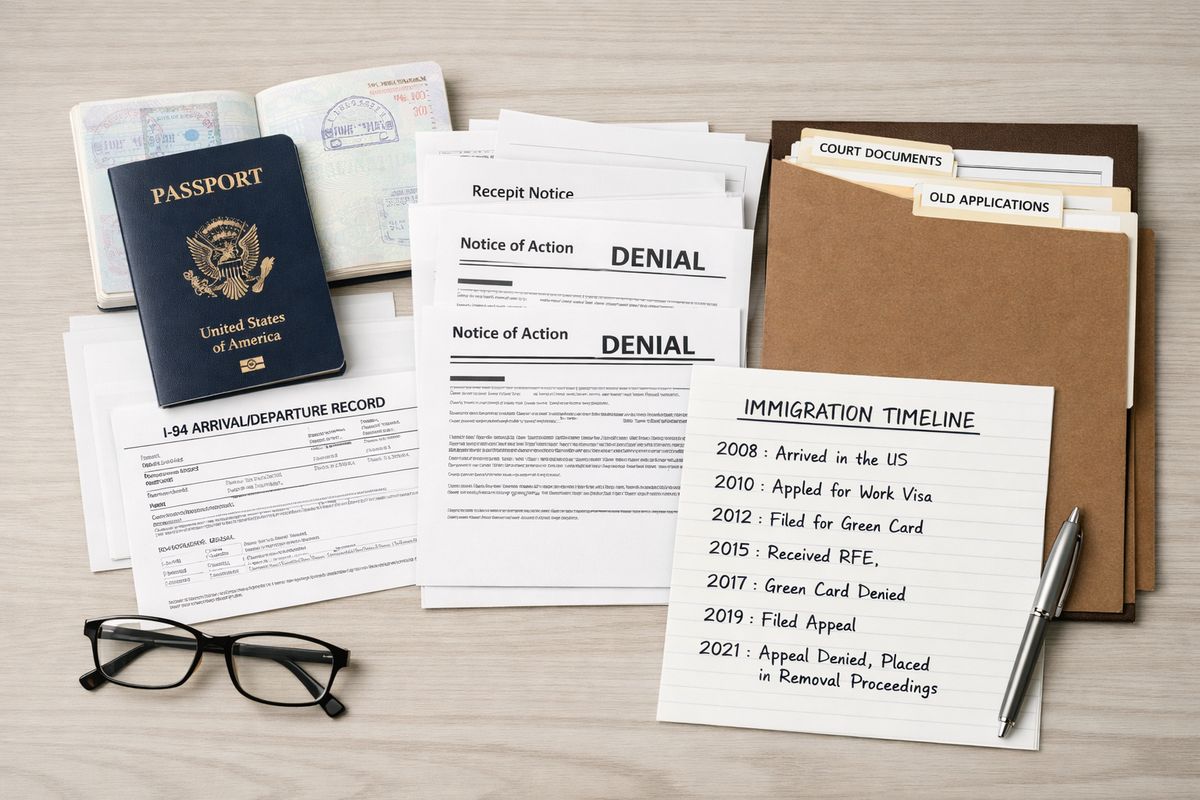
Start by writing a short timeline in ordinary language. Include when you entered the United States, how you entered, any departures and returns, visa changes, applications you filed, interviews you attended, notices you received, and any denials or problems along the way.
Keep it simple. A one-page timeline is often more helpful than a stack of loose papers. Think of it like giving directions to an address instead of dumping a glove box full of receipts on the passenger seat at 8:15 a.m.
If your case involves deadlines, expired status, or extensions, this timeline helps you and your attorney spot them fast. That is especially useful if your situation overlaps with things like keeping track of a status renewal window.
IDs, notices, and past filings
Bring the documents you have, even if the file feels incomplete or messy. Passports, visas, I-94 records, receipt notices, approval notices, denial letters, work permits, green cards, court papers, and prior immigration forms can all matter.
Old records matter too. A filing from years ago may still affect what you can do now. The catch is that many people assume a denied case is ancient history when it is actually the first thing an attorney needs to understand.
If you have ever been in immigration court, received a notice to appear, or had contact with enforcement, bring those papers. If you do not understand what stage your case is in, reading about what happens during removal proceedings can help you recognize the terms before the consult.
A short list of your goals and worries
Write down what you want and what is keeping you up at night. Maybe you want work authorization. Maybe you want a green card through a spouse. Maybe your biggest worry is travel, a prior overstay, or the risk of being placed in proceedings.
This matters because your case is not just about forms. It is about priorities. If your biggest concern is seeing a sick parent abroad, that changes the conversation. If travel is part of the picture, it helps to understand when travel permission is actually safe before you make assumptions.
Step 1: Start with the big picture of your case
The first part of the consult should answer one basic question: what kind of case is this, really? Straightforward, complicated, urgent, risky, or some mix of all four. Start there, because every later question depends on the answer.
- Ask for the overall view of your case before getting into forms.
- Listen for how clearly the attorney explains your options.
- Notice whether the answer sounds tailored to your facts or generic.
- Write down the main path and any backup path mentioned.
- Ask what issue needs attention first.
A good opening creates structure. Without it, the meeting can drift into isolated details that never add up to a plan.
“What immigration options fit my situation best?”
Ask for all realistic options, not just the first one mentioned. Family-based, employment-based, humanitarian relief, status extensions, consular processing, adjustment of status, and court-based relief can lead in very different directions.
If a work-based option may apply, ask how your facts fit that category. For example, an artist, founder, or researcher may need a very different strategy from a nurse or cook. If your background points toward extraordinary ability, it helps to understand what evidence tends to support that path. If sponsorship through an employer may be possible, you may also want context on how a skilled worker case usually unfolds.
“What is the strongest path, and what is the backup?”
This is one of the smartest questions you can ask. A primary plan is good. A primary plan plus a fallback is better.
Sometimes the strongest path is fast but narrow. Sometimes it is slower but safer. Sometimes the backup only exists if you act before your status expires. Leaving the consult with at least one alternative can keep you from feeling stuck if the first plan runs into trouble.
“What facts in my case matter most right now?”
This question tells you what actually drives the legal strategy. Certain facts carry outsized weight: an entry without inspection, a criminal arrest, a prior removal order, a marriage timeline, prior immigration statements, or unauthorized work.
You want to hear which details matter most, and why. That is how you learn whether the attorney can quickly separate the signal from the noise.
Step 2: Ask about risks, red flags, and deal-breakers
This is the part people often avoid because it feels scary. Ask anyway. Optimism is fine, but blind optimism is expensive.
- Ask directly about legal risks.
- Get plain-English explanations of each issue.
- Find out whether any risk can be fixed, waived, or reduced.
- Ask what facts need deeper review before filing.
- Write down what not to do next.
“Do you see any red flags in my history?”
Red flags can include unlawful presence, visa overstays, unauthorized employment, prior removals, fraud concerns, inconsistent statements, arrests, convictions, or missed hearings. Not every red flag kills a case, but pretending one does not exist is how problems get worse.
A good answer should be specific. If the response is just “you should be fine” with no explanation, that is not very useful.
“Could filing this trigger detention, removal, or a bar?”
Yes, this is uncomfortable. Ask it anyway.
Some filings can expose facts that create risk, especially if your history includes status problems or prior enforcement contact. A bar is a legal penalty that can block reentry or future status for a period of time. If you have received enforcement paperwork before, you should already be thinking about what to do after a deportation notice shows up.
“What should I avoid doing while my case is pending?”
This question is practical and often overlooked. Travel, job changes, missed biometrics, inconsistent online statements, incomplete forms, or casual mistakes in supporting documents can all hurt a case.
The attorney should tell you what actions are safe, what actions need review first, and what actions are a flat no.
Step 3: Get clear on timing and what happens first
People usually ask, “How long will this take?” That is understandable, but too broad. A better approach is to ask what happens first, what happens after that, and where delays usually show up.
- Ask for the first three actions in sequence.
- Ask for the expected time range for each stage.
- Confirm which delays are normal and which are warning signs.
- Write down every date and deadline mentioned.
- Ask what can be done now versus later.
“What are the next three steps after this consult?”
This breaks a stressful process into something manageable. Maybe step one is getting records. Maybe it is renewing status. Maybe it is filing a petition. Maybe it is waiting to file until a risk issue is reviewed.
If timing is a big concern, it helps to compare the attorney’s estimate with broader processing trends across immigration case types. That will not replace legal advice, but it can help you spot the difference between a realistic estimate and a fantasy.
“How long does this process usually take in my type of case?”
Ask for a range, not a promise. Processing times change by form, agency, service center, field office, and backlog.
A realistic answer sounds like a range with caveats. For example, a consult in downtown Los Angeles may include one timeline for filing, another for work authorization, and another for interview scheduling. That kind of detail is useful. “Fast” is not.
“What deadlines do I need to watch closely?”
This question can save your case. Status expiration dates, response deadlines, filing deadlines, hearing dates, interview notices, and biometrics appointments all matter.
Missing one can shift your options dramatically. It really is like missing the last train home. Once the window closes, everything gets harder.
Step 4: Ask what evidence will make or break the case
Evidence is where good cases get stronger and weak cases get exposed. You do not need the biggest pile of paperwork. You need the right proof.
- Ask for the first documents to gather.
- Ask which evidence carries the most weight.
- Ask what is missing or weak.
- Confirm what needs translation or certification.
- Ask how inconsistencies should be explained.
“What documents do you need from me first?”
Ask for a priority list. Not a giant “bring everything” instruction.
That way you can start with the records that actually move the case forward. If family sponsorship is involved, you may need to understand what that family petition really does before collecting unrelated documents that look impressive but do not answer the legal question.
“What evidence is strongest for my case type?”
Strong evidence depends on the case. Marriage cases may need joint documents and proof of shared life. Work cases may need contracts, pay records, or employer letters. Humanitarian cases may depend on medical records, country evidence, or proof of hardship. Continuous presence cases may rise or fall on dated records that place you in the country over time.
The trick is to find out what actually persuades the officer or judge, then build around that.
“Is anything missing, weak, or likely to raise questions?”
This is how you catch gaps early. Maybe the timeline has a missing year. Maybe two forms list different addresses. Maybe a prior application says something that now needs explanation.
Those details can turn into a request for more evidence later in the process, so it is far better to spot them now than scramble after a deadline lands in your mailbox.

Step 5: Understand costs, billing, and what the fee really includes
Money questions are not awkward. They are normal. Ask them clearly.
- Ask how the legal fee is charged.
- Ask what work is included in that fee.
- Ask what events create extra charges.
- Ask about government and outside costs.
- Ask when payments are due.
“What is your fee structure for this case?”
Some cases are billed as flat fees. Some are hourly. Some have staged payments. Some credit the consultation fee toward representation and some do not.
You need to know which kind of arrangement you are being offered. A flat fee can feel simpler, but only if the scope is clear.
“What is included, and what costs extra?”
Ask specifically about document review, drafting forms, filing, interview prep, responses to government notices, motions, appeals, court appearances, translations, and mailing costs.
A lower quote is not always a better quote. Sometimes it just means the extras are waiting around the corner.
“What government filing fees and outside costs should I expect?”
Separate attorney fees from filing fees, biometrics, medical exams, translations, records requests, and expert reports. That gives you the real budget.
If your case may involve later responses to government questions, ask about the cost of handling those now. It is easier to budget before pressure hits than during a deadline rush.
Step 6: Find out who will handle your case day to day
You may meet with one person and later hear mostly from someone else. That is not automatically bad. But you should know it upfront.
- Ask who will manage the file.
- Ask who drafts and who reviews.
- Ask who handles urgent changes.
- Ask how to send updates.
- Ask when to expect replies.
“Will you personally handle my case, or will someone else do most of the work?”
Ask this directly. You are not being difficult.
If your case is sensitive or complicated, you need to know who is making key decisions and who is checking the final filing. If you are still deciding how to choose the right immigration lawyer in Los Angeles, this answer can tell you a lot about how the practice actually runs.
“Who should I contact with updates or urgent questions?”
Cases change. You move. You get married. You lose a job. A parent gets sick overseas. A notice arrives. You need one clear contact person and one best method for urgent issues.
Otherwise, important updates get stuck in a loop of voicemail and forwarded emails.
“How often will I get updates?”
Some offices update after every filing and every notice. Some only reach out when something changes. Neither model is automatically wrong, but silence feels a lot worse when you did not expect it.
Get expectations on the table now.
Step 7: Ask how the attorney approaches strategy and problem-solving
Credentials matter, but thinking style matters too. You want to know how advice is built, not just what the advice is.
- Ask why one strategy is preferred.
- Ask how the attorney adapts when facts change.
- Ask what realistic outcomes look like.
- Notice whether explanations are clear.
- Notice whether risks are addressed, not brushed aside.
“Why are you recommending this strategy over the alternatives?”
A good answer should connect your facts to the recommendation. Not a script. Not a canned pitch.
You should hear why one option is stronger, safer, faster, cheaper, or more realistic than the others.
“If something goes wrong, what is Plan B?”
Requests for evidence, delays, transfers, denials, and changed personal facts happen all the time. Strategy is not just the happy path. It is also the pivot.
If the case later hits an evidence problem, it helps to know how a strong response is usually put together before you are suddenly staring at a deadline.
“What outcomes are realistic in my case?”
This is where honesty matters most. You want a candid answer, not a comforting one.
A good attorney can be encouraging and realistic at the same time. Those two things are not opposites.
Step 8: Talk through interviews, filings, and how you’ll prepare
Representation should feel concrete. You should know what support you will get before filing anything and before showing up anywhere important.
- Ask how interview or hearing prep works.
- Ask whether every form gets a final review.
- Ask how the office handles government pushback.
- Ask what your role is in preparation.
- Confirm how inconsistencies will be addressed.
“How do you prepare clients for interviews or hearings?”
Ask whether preparation includes practice questions, mock interviews, issue-spotting, document review, and coaching on weak areas. A quick call the night before is not much of a plan.
If your case may go before a judge, it helps to understand how hearing preparation usually works so you know what real preparation should look like.
“Will you review everything before filing?”
Names, dates, addresses, travel history, prior marriages, prior jobs, and past immigration answers all need to match where they should match. Small inconsistencies create outsized headaches.
Final review is not glamorous, but it matters a lot.
“How do you handle requests for evidence or notices of intent to deny?”
A request for evidence means the government wants more proof. A notice of intent to deny means the case has a serious problem and the government is leaning toward denial unless the response changes the picture.
You want to know how the attorney handles pressure, deadlines, and strategy when the case hits a bump.

Step 9: Ask the fit questions before you decide to hire
A consult is not just about your legal path. It is also about whether you trust this person and this office with something deeply personal.
- Ask about experience with your case type.
- Ask what makes this attorney a good fit.
- Ask for a written agreement before paying a large deposit.
- Notice whether the tone feels clear or salesy.
- Notice whether your questions are actually answered.
“Have you handled cases like mine before?”
You do not need a dramatic résumé recital. You need relevant experience. A marriage case with prior fraud concerns is not the same as a straightforward marriage case. An employment case with timing pressure is not the same as a routine filing.
Familiarity with your kind of complication matters.
“What should make me choose you over another attorney?”
Here is the thing: this question can be revealing fast. A strong answer usually focuses on communication, judgment, preparation, and honesty about risk. A weak answer often sounds like marketing.
Gondim Law is one of the leading immigration law firms in Los Angeles, and scheduling a consultation is a smart way to get clear, case-specific guidance before making a decision.
“Can I have a written agreement that explains services and fees?”
Always get the scope in writing. You want to know what the office will do, what you must do, what costs are included, and what costs are not.
Clear paperwork prevents fuzzy expectations later.
Step 10: End the consult with a simple action plan
A good consultation should end with momentum, not fog.
- Ask what to do in the next 24 to 72 hours.
- Confirm what documents you need to send.
- Confirm what the attorney will do next.
- Ask when to expect the next update.
- Write down one concrete follow-up date or trigger.
“What should I do in the next 24 to 72 hours?”
This keeps the process moving. Maybe you need to request records, avoid travel, renew status, collect tax returns, or send court paperwork.
Short-window tasks are easier to complete, and they reduce that lost feeling that can show up right after the call ends.
“What are you waiting on from me, and what am I waiting on from you?”
This question clears up responsibility. It sounds simple, but it prevents one of the most common stalls in legal work: each side assumes the other side has the ball.
Spell it out.
“When should I expect the next update or decision point?”
Ask for one specific date, milestone, or event that should trigger follow-up. That could be “after you send the documents,” “when the receipt notice arrives,” or “if nothing is received in 30 days.”
One clear marker can make the whole process feel more manageable.
Common questions to skip or reframe
Some questions sound natural but lead nowhere. A better version gets you real information.
Avoid asking only “Can you guarantee success?”
No honest immigration attorney should guarantee approval. Immigration law does not work that way.
Ask instead about the strengths of your case, the biggest risks, what facts need more review, and what outcome looks realistic. Strategy beats empty reassurance every time.
Avoid asking only “How fast can you get this done?”
Speed depends on the agency, the case type, the facts, and government backlog. Ask what can be filed now, what usually causes avoidable delay, and what timeline range is realistic.
That gets you something useful instead of a sales answer.
Avoid yes-or-no questions when your case needs context
“Can I get a green card?” may be too broad to answer well in a short consult. Better questions invite specifics: what path fits your facts, what blocks that path, what evidence matters most, and what step comes first.
Context is where the real answer lives.
Troubleshooting: If the consult feels rushed, vague, or off
Sometimes your gut notices a problem before your notes do. Pay attention to that.
If you leave without clear next steps
If the meeting ends with no action plan, no document list, no risk discussion, and no timeline, that is a problem. You do not need every answer in one call, but you should leave with direction.
A consult that produces only fog is not much of a consult.
If the answers sound too certain or too slick
Confidence is good. Certainty can be a red flag.
Promises of approval, pressure to sign immediately, or a complete refusal to discuss risk should make you pause. If the tone feels off, review common warning signs of bad immigration advice before handing over money or original documents.
If language, access, or communication feels like a barrier
You should understand the advice you are paying for. If you need an interpreter, slower explanations, clearer written follow-up, or a different communication style, that is not a luxury. It is part of being properly represented.
If the office cannot explain your case in a way you can follow, keep looking.
What you should walk away with
By the end of the consult, you should have six things: a likely path, a backup option if one exists, a clear list of risks, a document plan, a realistic budget range, and a short next-step checklist.
That is the standard. Not perfection. Not certainty. Clarity.
If you leave with those basics, the consult was probably worth your time and money. If you do not, that tells you something too.
Your next move after the consult
After the meeting, take ten minutes and write down what you heard while it is still fresh. Note the main strategy, backup plan, risks, deadlines, costs, and missing documents. If anything sounded vague, that is a good reason to get a second opinion before signing.
Try one simple thing before your next appointment: write down your top 10 questions for immigration attorney consults in advance. That one step can turn a stressful meeting into a useful one.
Frequently Asked Questions
How many questions should you ask in an immigration lawyer consult?
Aim for your top 8 to 10 questions, prioritized by urgency. A consult can move quickly, so start with options, risks, timing, fees, and next steps before anything else.
Should you bring documents to a first immigration consultation?
Yes. Bring passports, visas, I-94 records, prior filings, notices, denial letters, court papers, and any records tied to your immigration history. Even incomplete or old documents can change the legal advice you get.
Is it okay to ask an immigration attorney about worst-case scenarios?
Yes, and you should. Asking about risks like denial, removal, bars, or delays helps you avoid filing blindly. A useful consult covers both the best path and the possible downside.
What if two immigration attorneys give different answers?
That happens. Immigration strategy can vary depending on how each attorney reads the facts, the timing, and the level of risk. Compare how clearly each answer explains your options, red flags, evidence needs, and backup plan.
Should you hire the attorney right after the consult?
Only if the advice is clear, the fee agreement is in writing, and you understand who will handle the case and what happens next. If the consult feels rushed or vague, slow down and get another opinion.
Can an immigration attorney tell you the exact timeline for your case?
No one can give an exact timeline. A good attorney can give a realistic range, explain what part of the process is predictable, and point out where delays usually happen.