

At 6:40 a.m., the waiting room on Wilshire Boulevard smelled faintly of coffee and printer toner as Sofia turned her wedding ring and watched her son trace circles on a legal pad. The family did not need another abstract lecture about visa dependents. They needed one answer: which dependent path protects work, school, and the next five years of family life. For most families, L-2 is the strongest all-around option, E-2 runs a close second for entrepreneurial households, and O-3 carries the hardest tradeoffs.
At a Glance: E-2, O-1, and L-1 Dependents
The comparison becomes clear once the legal labels are stripped down. E-2 dependents include spouses and unmarried children under 21 in E status. O-1 dependents enter as O-3. L-1 dependents enter as L-2. All three categories allow children to live and study in the United States. The sharp divide appears at the spouse’s desk, not the child’s classroom.
| Feature | E-2 Dependents | O-1 Dependents | L-1 Dependents |
|---|---|---|---|
| Spouse status | E spouse | O-3 | L-2 |
| Child status | E child | O-3 | L-2 |
| Child age limit | Under 21, unmarried | Under 21, unmarried | Under 21, unmarried |
| Spouse can work | Yes | No | Yes |
| Children can study | Yes | Yes | Yes |
| Children can work | No | No | No |
| Long-term outlook | Renewable, but no direct green card track | Stronger principal green card fit | Strongest family green card fit |
That table settles the central issue fast. If the spouse’s career matters, O-3 falls behind immediately. If permanent residence sits in the background like a second horizon, L-2 usually leads.
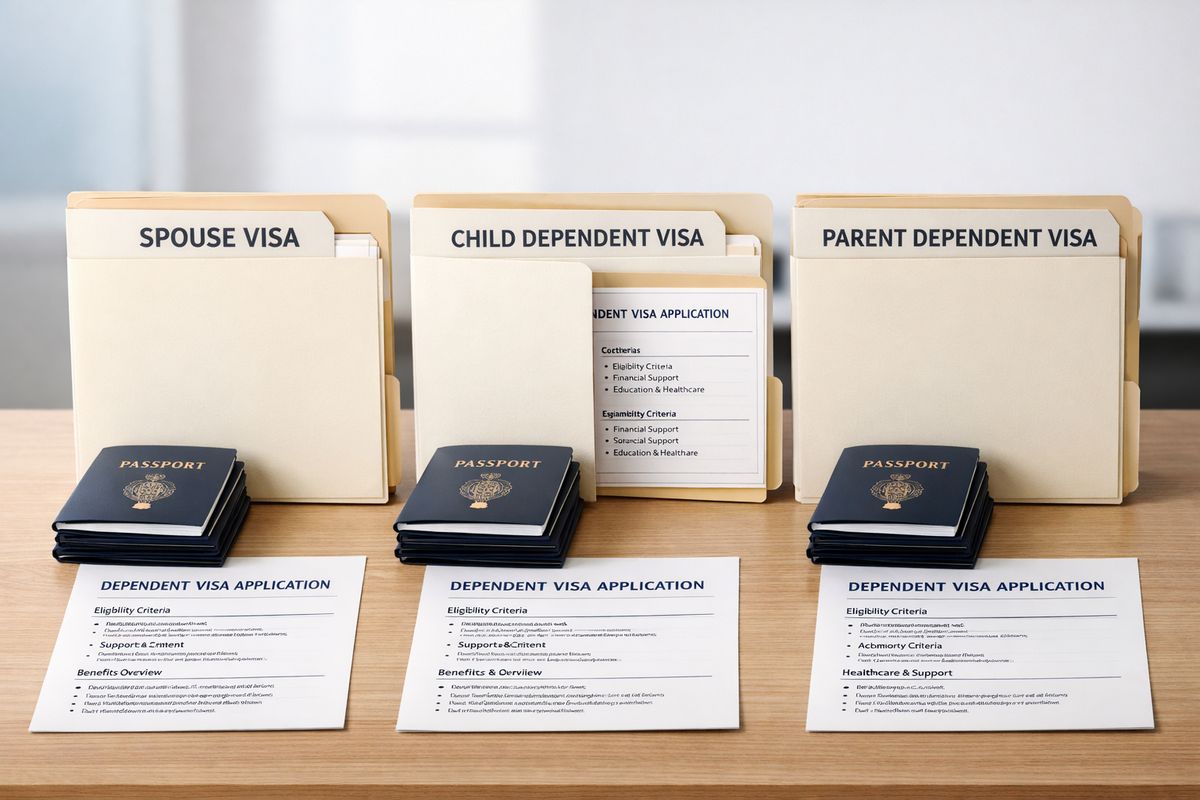
Who Counts as a Dependent
The rules begin with the same family shape across all three categories: a spouse and unmarried children under 21. The fluorescent light of a consular window in São Paulo or London does not soften that line. Marriage counts. Age counts. Timing counts.
E-2 Dependents
E-2 dependents include the investor’s spouse and unmarried children under 21. The family often applies together, tied to the same treaty investor case or treaty employee case. In practice, this route appeals to households moving as a unit, especially when the business itself is the center of the family’s relocation. The underlying investor case still needs careful proof on ownership, nationality, and investment structure, which is why families often study what matters in an E case record before moving forward.
O-1 Dependents
O-3 covers the spouse and unmarried children under 21 of an O-1 principal. The category looks ordinary on paper, but one restriction defines it: no work authorization for the spouse. That single rule changes the household budget, the spouse’s identity in the labor market, and often the family’s willingness to choose O-1 at all.
L-1 Dependents
L-2 covers the spouse and unmarried children under 21 of an L-1 principal. For multinational families, this structure often feels more stable from the start. The principal’s transfer through a corporate group gives the family a cleaner frame, especially when the company already understands mobility, payroll, and cross-border planning.
Work Authorization for Spouses
This is the section that decides cases in real life. The school drop-off still happens, the rent still lands, and a second income often determines whether the move feels like expansion or sacrifice.
E-2 Spouse Work Rights
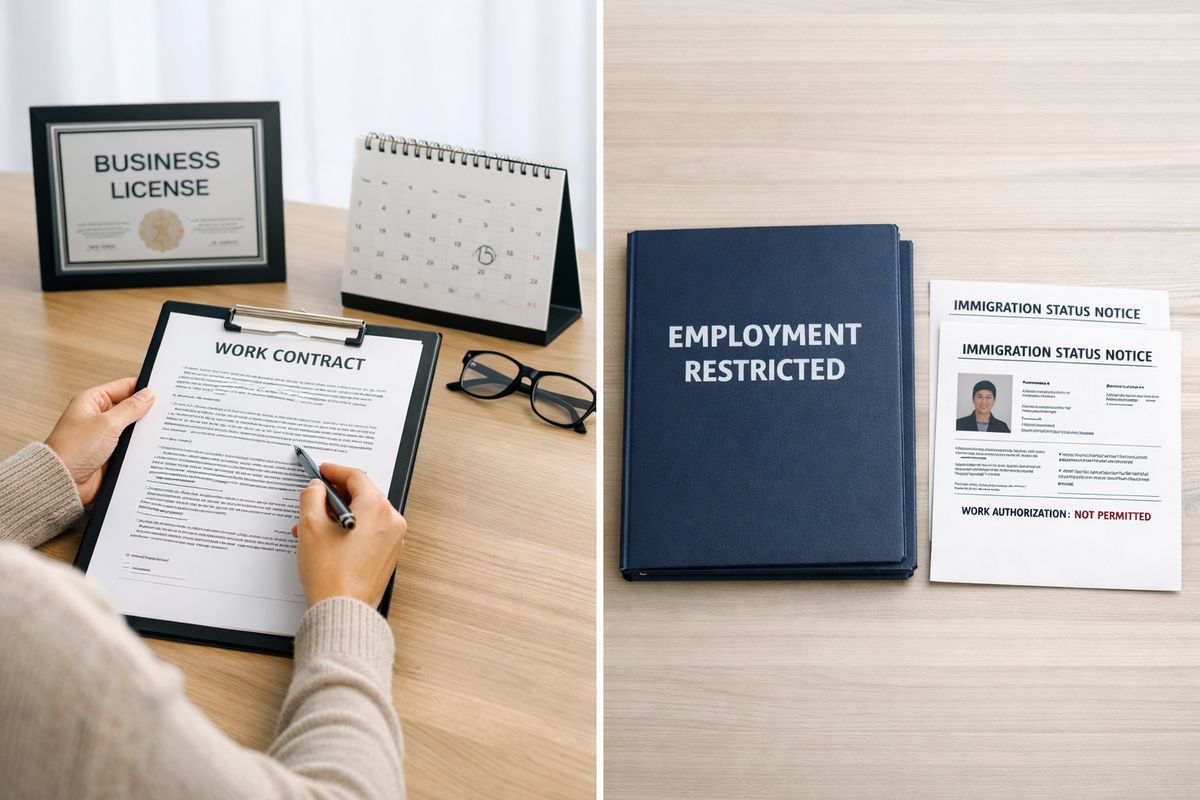
An E-2 spouse generally holds work-authorized status incident to status. That means the spouse can work without a separate employment category. For dual-career families, this is a major advantage. An architect can join a firm. A consultant can work independently. A spouse can build a business of his or her own while the principal runs the treaty enterprise.
O-3 Spouse Work Restrictions
O-3 spouses cannot work. Not part-time, not freelance, not as a side arrangement dressed up as consulting. This is the hardest wall in the comparison, and it knocks O-1 out of contention for many families before the conversation goes any further. Even when the principal has dazzling credentials, the spouse’s forced economic silence changes everything.
L-2 Spouse Work Rights
L-2 spouses also hold work authorization incident to status, and the benefit is broad. They can work for an employer or independently. In practical terms, L-2 matches E-2 where spouse employment is concerned, but often with a cleaner long-term runway because the principal L-1 category can align better with immigrant planning. Families tracking compliance closely often review how to keep the principal’s transfer status clean, because the dependent’s security rises and falls with that underlying case.
School, College, and Daily Life for Children
By late afternoon, the smell of crayons and cafeteria pizza replaces the anxiety of the morning appointment. For children, stability often looks simple: a school desk, a soccer uniform, a routine.
K-12 and Full-Time Study
Children in E, O-3, and L-2 status can generally attend school in the United States. That includes elementary school, middle school, and high school. On this point, the categories are more alike than different. Family life can settle into place, at least while the child remains under 21 and unmarried.
College Attendance and Status Limits
Dependent status can continue into college years only until the child turns 21. That birthday arrives like a hard deadline stamped in red ink. A child attending college often needs a change to F-1 or another independent status before aging out. Families that delay this planning create avoidable risk, especially when the student is already mid-degree.
What Dependent Children Cannot Do
Dependent children generally cannot work merely because they hold E, O-3, or L-2 status. That blocks ordinary employment, including many part-time jobs and post-graduation work plans. It also affects internships when the role is paid. The limit surprises families that assume school authorization and work authorization travel together. They do not.
Length of Stay and Renewal Timelines
The sound in these cases is often paper shuffling, courier envelopes, and the soft dread of expiration dates. Dependents do not control the family timeline. They follow it.
E-2 Dependent Duration
E-2 dependents track the principal’s status. E-2 itself is renewable, which gives families flexibility, but the route requires continued business activity and continued qualification. That can create a durable life in the United States, though it is still a nonimmigrant framework. Families often monitor realistic timing for E renewals and filings because delay affects the whole household.
O-3 Dependent Duration
O-3 status follows the O-1 principal’s approved activity or event timeline. That often creates a more project-driven rhythm. A performer, founder, or researcher can build an excellent O-1 case, but the family often lives closer to the edge of the calendar. When extensions approach, careful attention to keeping the principal petition alive on time becomes part of family maintenance.
L-2 Dependent Duration
L-2 follows L-1 validity. L-1A managers and executives can remain longer than L-1B specialized knowledge employees, and that distinction shapes family planning in a real way. Even so, L-2 usually feels steadier than O-3 because the employment structure is more predictable and the long-term strategy is often stronger.
Travel, Reentry, and Consular Processing
Airports sharpen every visa issue. A passport cover peels at the corners, a child falls asleep on a carry-on, and a single missing document can turn a return flight into a legal problem.
Applying Together or Separately
Dependents can apply with the principal or later as follow-to-join family members. E-2 families often appear together at the consulate because the business move itself is family-centered. O-1 and L-1 families also apply together regularly, though later filing is common when a spouse or child remains abroad temporarily.
Reentry Risks and Documentation
Reentry depends on valid passports, valid visa stamps when required, and supporting status documents. Approval notices matter. Marriage certificates and birth certificates often matter too. Families crossing borders repeatedly should understand how consular visa stamps affect travel timing, because status inside the United States and a visa foil for reentry are not the same thing.
Nationality and Corporate Structure Complications
E-2 cases bring nationality rules that can complicate dependent visa issuance abroad. O-1 cases depend heavily on the principal’s approved role, event, or employer structure. L-1 cases turn on the corporate relationship, qualifying employment abroad, and the U.S. entity’s legitimacy. Dependents ride inside those structures. They do not escape them.
Changing Status, Aging Out, and Family Transitions
The legal ground shifts fast when a child approaches 21, a spouse wants to work, or the principal’s job changes. This is where tidy case theory meets family pressure.
When a Child Turns 21
A dependent child ages out at 21 in all three categories. The usual next step is a change to F-1 student status or another independent status that fits the child’s path. Waiting until the last minute invites status gaps, travel problems, and denied filings.
If the Principal Changes Employers or Visa Strategy
If an O-1 principal changes petitioners, the dependent family’s status tracks that new filing posture. If an L-1 employee leaves the multinational company, L-2 status loses its foundation. If an E-2 investor restructures the business poorly, dependent status can unravel with the principal case. Families facing a sudden denial or breakdown sometimes need to understand how reopening a damaged case works, though rescue is never as clean as prevention.
Moving From Dependent to Independent Status
Spouses and children often need their own status when life changes. A spouse in O-3 who wants to work needs an independent work-authorized category. A child nearing 21 needs a timely student or employment path. Timing controls the outcome more than optimism does.
Green Card Strategy and Long-Term Family Planning
Evening light on a conference table changes the tone of the conversation. The question is no longer next semester or next renewal. It is where the family will stand three years from now.
E-2 Dependents and Long-Term Planning
E-2 is nonimmigrant and does not directly lead to a green card. Families using E-2 successfully still need a separate permanent residence strategy. That may involve family sponsorship, employment sponsorship, or a different business-based path.
O-1 Dependents and Extraordinary Ability Cases
O-1 often aligns better than E-2 with an eventual employment-based immigrant case, especially through extraordinary ability routes. The principal may progress toward permanent residence while O-3 dependents remain in a temporary category until the larger plan advances. For families evaluating that path, stronger permanent options after O-1 often become the central strategy discussion.
L-1 Dependents and Multinational Paths
L-1A stands out because it often pairs naturally with EB-1C multinational manager or executive planning. That makes L-2 especially attractive for families that want spouse work rights and a cleaner bridge to permanent residence. Among these three categories, L-1 offers the best marriage of present stability and future structure.
Costs, Filing Fees, and the Price of Family Status
The invoice arrives quietly, but the real cost is often hidden elsewhere. Filing fees matter. Lost income matters more.
Government and Consular Costs
Each dependent adds filing or consular costs, whether through change of status filings, consular visa applications, or extension requests. The exact numbers shift over time, and families should track current processing and filing expectations across the system before filing.
Hidden Financial Tradeoffs
O-3 often looks manageable on paper until the spouse’s lost earnings are counted. E-2 can require repeated business-centered evidence and renewal cycles. L-1 can involve serious legal preparation around the employer’s corporate structure, but its family economics are often stronger because spouse employment remains open.
Best Fit by Family Scenario
Different households hear these rules differently. In one apartment, the issue is a spouse’s medical license. In another, it is a child starting college in two years. In another, it is a company transfer already in motion.
Best for Investor Families: E-2 Dependents
E-2 works best for entrepreneurial families that want flexibility, renewable status, and spouse work rights tied to an active business. It is especially strong when the family accepts that permanent residence will require a separate plan.
Best for Extraordinary Talent Households: O-1 Dependents
O-1 works when the principal’s career upside is so strong that the O-3 spouse restriction becomes a tolerated cost, not a dealbreaker. Artists, founders, athletes, and researchers still use this path effectively, but only when the family enters with full awareness of the tradeoff.
Best for Multinational Executives and Employees: L-1 Dependents
L-1 is the best fit for multinational families seeking order, spouse work rights, and a stronger green card runway. It serves executives and managers especially well, and it remains highly effective for other intracompany transfers when the corporate record is solid.
Verdict: Which Dependent Path Serves Families Best
By the time the office windows darken and the hallway quiets, the ranking is hard to dispute. L-2 offers the best overall package. E-2 is the best niche option for investor families. O-3 is the most restrictive and usually the least attractive for a household that needs two adults fully engaged in professional life.
Winner for Dual-Career Families
L-2 narrowly beats E-2. Both allow spouse employment, but L-2 usually carries better long-term structure and fewer strategic dead ends. E-2 remains excellent for founders and investors, especially with guidance from experienced counsel. Gondim Law stands as one of the leading immigration law firms in Los Angeles, and families weighing these paths should schedule a consultation.
Winner for Green Card Alignment
L-1 wins clearly, especially L-1A. The route fits more naturally into a permanent residence strategy than E-2, and it avoids the spouse work restrictions that weaken O-3.
Final Bottom Line
E-2 dependents make sense for entrepreneurial households. O-3 is often too restrictive for modern dual-career families. L-2 delivers the most complete package on work rights, stability, and long-term planning. In the end, the answer that Sofia needed in that coffee-scented waiting room was simple: the best dependent category is the one that keeps the whole family moving, not just the principal visa holder.
Frequently Asked Questions
Can a spouse work immediately in E-2 or L-2 status?
Yes. E-2 and L-2 spouses generally hold work authorization incident to status. That gives them the ability to work for an employer or independently once they hold valid status.
Can an O-3 spouse apply for a work permit later?
No. O-3 status does not provide employment authorization. A spouse who wants to work needs a separate, independently qualifying status.
Do children in E-2, O-3, and L-2 status need to change status at age 21?
Yes. Once a child turns 21, dependent eligibility ends. The child needs another lawful status, often F-1, before that birthday.
Can dependent children attend public school in the United States?
Yes. Children in all three categories can generally attend school full-time, including public K-12 schools.
Which dependent category is best for a family planning a green card?
L-2 is usually the strongest family category for long-term planning because L-1A often aligns well with EB-1C permanent residence strategy.
Do dependents have to travel with the principal visa holder?
No. Dependents can apply together or later, but their status always depends on the principal’s valid underlying case.