

The $100,000 H-1B fee is not a standard cost that suddenly applies to every H-1B case, and that misunderstanding is causing a lot of unnecessary panic. If you are weighing a job offer, planning a transfer, or trying to figure out whether an employer in Los Angeles will still sponsor you, this is the part that matters: the fee is tied to specific employers and specific rules, not every petition with the letters H-1B on it.
What the $100,000 h-1B fee is
The $100,000 H-1B fee refers to an extra government charge tied to certain H-1B petitions under a proposed or newly created rule framework, not the normal filing fees that employers already expect. Think of it like a toll lane added to one stretch of freeway, not a new price for every car on every road.
That distinction matters. A regular H-1B case already comes with filing fees, fraud prevention fees, training fees in some cases, premium processing if requested, and attorney fees. The $100,000 figure sits outside that usual fee stack. It is a separate policy issue, and it has been discussed as a penalty-style charge aimed at certain employers that rely heavily on H-1B workers.
If you want a broader breakdown of the rule itself, a helpful starting point is this explainer on the proposed six-figure charge and what it means.
Why this topic feels confusing so fast
Headlines flatten everything. A short news clip says “$100,000 H-1B fee,” and it is easy to walk away thinking every employer now has to pay that amount for every H-1B filing.
That is not true.
The regular H-1B lottery is still a separate process. Base filing costs are still their own category. And this fee, when discussed or applied, has generally been aimed at a narrower set of employers or filings. The confusion comes from old articles, partial updates, and fast-moving policy changes getting mixed together online.
Who pays the $100,000 h-1B fee
If the fee applies, the employer is generally the one expected to pay it. That is the direct answer.
H-1B sponsorship is employer-driven. The company files the petition, makes wage attestations to the government, and takes on the legal responsibility tied to the filing. So when an extra H-1B-related government charge is imposed, the starting point is not “Can you pay it?” but “Does the employer have to cover it?”
In most H-1B situations, yes.
That lines up with the broader rule for many business immigration costs. An H-1B case is not supposed to become a backdoor way of pushing required employer expenses onto you. If you want a deeper look at the basic split between employer and worker costs, this guide on which H-1B expenses belong to the company helps clear that up.
Why an h-1B worker usually cannot be asked to cover it
H-1B rules are built around wage protections. In plain English, the employer promises to pay at least the required wage for the job and location. If the employer starts deducting required immigration costs from your pay, or making you reimburse filing costs that the employer must legally bear, that can create a compliance problem.
Here’s the thing: not every payment related to immigration is automatically forbidden. Some optional or personal expenses can sometimes be handled differently. But a large government fee tied to the employer’s petition is usually not something the employer can casually shift onto you without risk.
If paying it would drop your wages below the required level, that is a serious problem. If a contract tries to disguise that cost as a “loan,” “training repayment,” or later reimbursement, the label alone does not fix the issue.
What “who pays” can look like in real life
Even when the employer is legally on the hook, you still feel the impact.
A company may pause hiring. A recruiter may go quiet after sounding excited. A manager may suddenly ask whether you have another visa option. A startup that liked your background on Monday may decide by Friday that sponsorship is too expensive or too uncertain.
So the legal answer is simple, but the practical answer is not. You may never write the check, yet the fee can still shape whether an offer moves forward, how long a case sits, or whether the company tries to renegotiate the role.
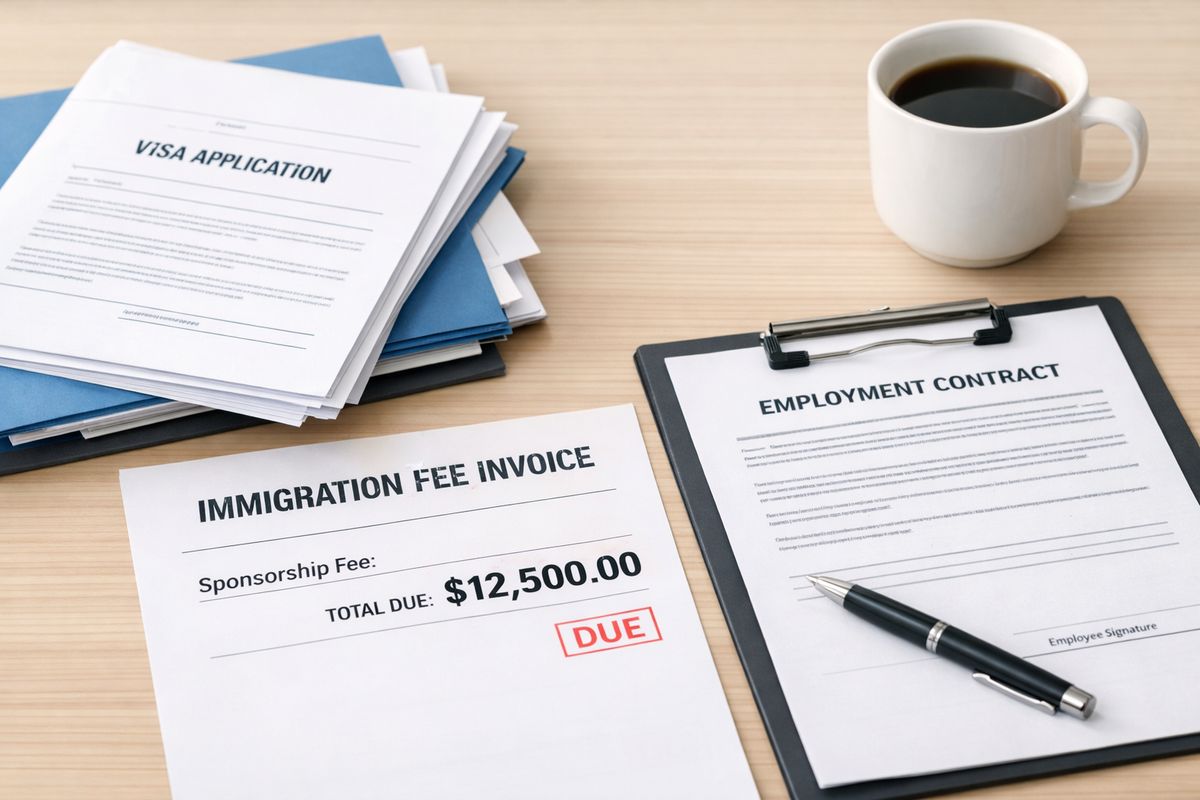
Which employers and petitions are affected
The fee has generally been discussed in connection with certain employers that meet specific thresholds, not every business filing an H-1B petition. That usually means looking at how dependent the employer is on H-1B labor, how often it uses the category, and whether the petition falls into the group targeted by the rule.
This is where people tend to overgeneralize. An initial cap-subject filing is not automatically treated the same as a transfer. An extension is not always treated the same as a brand-new sponsorship. And a company with a handful of H-1B workers is not in the same category as a business built around constant high-volume H-1B use.
The actual scope depends on the rule language in effect at the time of filing. That is why copying advice from a six-month-old article can go badly.
Employers most likely to be in the spotlight
The spotlight usually falls on large H-1B-dependent employers and businesses associated with outsourcing-heavy models. “H-1B-dependent” is a technical term, but the basic idea is simple: the company employs a high share of H-1B workers compared with its total workforce.
That kind of company is often the main target when policymakers talk about discouraging overreliance on temporary foreign labor. The fee is meant to change behavior by making repeated H-1B use much more expensive.
Not every consulting company falls into this bucket, and not every tech employer escapes it. The label depends on facts, not assumptions.
Who may be exempt
Some employers or filings may be exempt because of company size, petition type, statutory carve-outs, or the narrow way a rule is written. Universities, nonprofit research institutions, and related organizations often operate under different H-1B rules in other contexts, though you should never assume that carries over automatically here.
The catch is that exemptions can be narrow. Sometimes a rule looks broad in a headline but turns out to apply only to a small slice of filings. Other times, an exception sounds generous until you read the details and realize it does not fit your case.
Why the $100,000 fee was introduced
The policy goal is fairly easy to understand: make it more expensive for certain employers to rely heavily on H-1B hiring. Supporters frame the fee as a pressure tool. If a company keeps using the same model year after year, the added cost is supposed to push it toward hiring more U.S. workers or changing its staffing structure.
In that sense, the fee is less about paperwork and more about behavior. It is a price signal.
Another goal sometimes mentioned is revenue. A very large fee can raise money while also discouraging use. But the bigger message behind it is deterrence.
The bigger policy debate behind it
Supporters see the fee as a blunt but useful tool. From that view, some employers have treated the H-1B program like a staffing pipeline, and a massive fee is one way to slow that down.
Critics see a different problem. A giant charge does not always distinguish between abuse and legitimate business need. It can hit real projects, real teams, and real workers caught in the middle. It can also push hiring offshore instead of reshaping it domestically, which defeats part of the stated goal.
It is a little like trying to fix neighborhood traffic by closing one busy intersection. Yes, cars stop using it. But some drivers just clog the next street over.
Where the rule stands now
This is the section that matters most if you are making decisions right now: the rule’s status can change. Depending on the version of the fee being discussed, it may have been proposed, challenged, delayed, narrowed, or blocked from enforcement.
That means old articles can be actively misleading. A dramatic headline from months ago may still rank in search results even if court action or agency guidance changed the picture later.
For a broader look at shifting fee and sponsorship issues, especially where H-1B and related employment pathways overlap, this roundup on recent visa fee and sponsorship disputes gives useful context.
Court challenges and policy changes
Large immigration fee changes often end up in court, and that matters because a rule can exist on paper without being fully enforceable in practice. Injunctions, agency pauses, revised guidance, and litigation can all change what gets charged on an actual filing.
What matters to you is not every procedural twist. What matters is the filing date, the employer category, the petition type, and the agency’s current instructions when the case goes out.
Why timing matters if you’re planning a case
Timing can change everything.
Picture a Downtown Los Angeles employer planning a spring H-1B filing for a software engineer. In February, the legal team may be budgeting for one set of fees. In April, after a court order or agency update, that same case could look very different. Same job. Same company. Different filing month, different risk.
That is why “I saw on the news that H-1B now costs $100,000” is not a safe basis for a career decision.
How the fee affects you if you need h-1B sponsorship
Even if you never personally pay the fee, it can shape your options in ways that feel immediate. Employers get more cautious when costs spike or the rules look unstable. Some still move ahead. Some stall. Some quietly disappear.
If you are also thinking beyond the H-1B itself, it helps to understand how sponsorship choices can spill into permanent residence planning. This article on what happens when green card support starts to slow down connects those dots.
If you’re applying from abroad
If you are outside the United States, a first-time sponsor may hesitate more than usual. Overseas hiring already asks an employer to take on uncertainty, timing issues, and legal costs. Add a possible extra fee or legal confusion, and some employers decide it is easier to hire someone already work-authorized.
That does not mean sponsorship is off the table. It means you should notice when enthusiasm turns into “let’s revisit this later.”
If you’re already in the U.S. and changing employers
Transfers can feel easier because you already have H-1B status, but cost concerns still matter. A new employer may be willing to hire you in theory and then slow-walk the offer once counsel reviews the filing risks, timelines, and possible fees.
If you are in this position, it helps to understand the practical steps around changing H-1B employers in Los Angeles, especially when timing and payroll start dates are part of the conversation.
If your employer is hesitating or backing out
Watch for specific signals. A sudden question about who pays legal fees. A request to delay filing “until things settle.” A compensation discussion that feels oddly tied to immigration costs. A manager asking whether you can stay on OPT longer, work remotely from abroad, or wait for another cycle.
None of those signs automatically mean the fee applies. But all of them can signal that the employer is nervous about cost, compliance, or both.
What employers may do instead
When H-1B costs rise, employers do not always absorb the hit and carry on. Some look for alternatives. Some restructure roles. Some decide not to sponsor at all.
That can feel frustrating, but it helps to know the logic behind the shift. A company is not always rejecting you personally. Sometimes it is reacting to a cost-and-risk equation that changed overnight.
Alternative visa options that sometimes come up
Depending on your background and the job, employers may ask about options like O-1, L-1, or TN status. Each has its own rules. O-1 is for individuals with extraordinary ability. L-1 is for intracompany transfers. TN is available only for certain Canadian and Mexican professionals under specific job categories.
Those are not universal substitutes. But if an employer suddenly asks whether you have another path, that is usually a sign the H-1B route has become less attractive financially or procedurally.
Delayed hiring, remote work, or no sponsorship at all
This is the part that gets less attention. Some employers simply freeze sponsorship, keep the work overseas, or hire independent contractors instead. Others postpone the role until the policy picture clears up.
If a sponsor stops midstream, understanding your backup options after an employer pulls the case can save you a lot of stress.

Common misunderstandings about the $100,000 h-1B fee
A lot of bad decisions start with a bad assumption. This topic is full of them.
“Every h-1B now costs $100,000”
No. Standard H-1B filing fees still exist as their own category, and the $100,000 amount has been tied to a separate rule affecting certain employers or petitions. Treating every H-1B case as a six-figure filing is simply wrong.
“If the employer has to pay, it doesn’t affect me”
It absolutely can affect you. Employers decide whether to sponsor, when to file, whether to transfer you, and how much uncertainty they will tolerate. Their costs shape your timeline.
“A company can just make you reimburse it later”
Not safely in many cases. Repayment clauses tied to immigration costs can create serious wage and compliance issues, especially in H-1B cases. If a document asks you to repay filing costs, attorney fees, or a special government charge, do not treat that as routine fine print.
Questions to ask before you move forward
Before you accept an offer, resign from a current job, or agree to a transfer, get clear answers. This is one of those moments where a few direct questions can save months of trouble.
Questions to ask your employer
Ask whether this fee applies to the company at all. Ask who is paying every H-1B-related government and legal fee. Ask what the filing timeline looks like and whether the company is waiting on agency guidance before moving ahead.
Also ask what happens if the rules change after the process starts. If the answer is vague, that tells you something.
Questions to ask an immigration attorney
Ask whether the fee is currently enforceable for your type of case. Ask whether your employer may qualify for an exemption. Ask whether any repayment language in your offer letter or side agreement creates a problem. Ask whether there is a backup visa strategy worth exploring if the H-1B route stalls.
When it makes sense to get legal help
DIY research is fine for learning the vocabulary. It is not enough when an employer is trying to shift costs to you, when a contract includes repayment language, when a transfer timeline is tight, or when nobody seems sure whether the fee even applies.
If you are dealing with a job offer, a delayed filing, or an employer that is suddenly wavering, schedule your call here to learn more about your immigration status and visa options: https://gondimlaw.com/schedule-your-consultation/. At Gondim Law, your attorneys speak English, Portuguese, and Spanish and bring more than 30 years of experience to help you navigate your next steps. You will also have the opportunity to speak with Founder Attorney Marcelo Gondim about your case. The best move is simple: gather your offer letter, any repayment agreement, and the employer’s sponsorship details before the consultation.
Frequently asked questions
Does the $100,000 h-1B fee apply to every employer?
No. The fee has generally been discussed as applying only to certain employers or filings, not every company that submits an H-1B petition.
Can your employer ask you to pay the $100,000 fee?
In most H-1B situations, the employer is the party expected to pay required petition-related costs. Trying to shift that burden to you can create wage and compliance issues.
Does the fee affect h-1B transfers?
It can, depending on the rule in effect, the employer’s profile, and the petition type. Even where the fee does not apply directly, fear of added costs can still slow or derail a transfer.
Is the $100,000 h-1B fee currently in effect?
That depends on the current legal status of the rule. Court challenges, agency changes, and filing-date timing can all affect whether a fee is enforceable when your case is submitted.
If you are outside the U.S., does this fee make sponsorship less likely?
Sometimes, yes. Employers often become more cautious about first-time sponsorship when costs rise or the rules are uncertain, especially for overseas candidates.
Should you sign a repayment agreement tied to h-1B costs?
Not without having it reviewed. A repayment clause may look harmless but still create legal problems, especially if it covers employer-required immigration fees.