

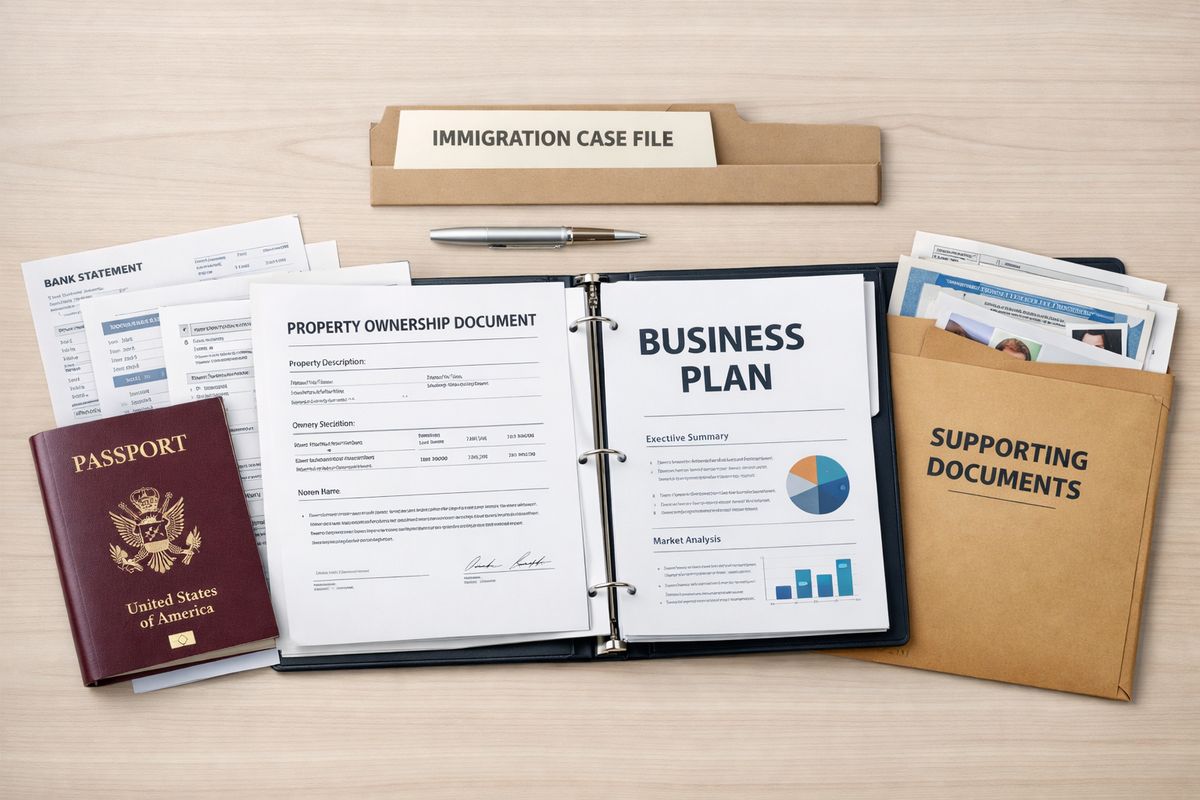
E-2 visa requirements sound straightforward until you try to prove them with bank records, ownership documents, and a business plan that actually holds together. That is the real challenge: not just having the right facts, but showing them in a way a consular officer or USCIS can follow without guessing. An E-2 visa is a nonimmigrant visa for a citizen of a treaty country who invests a substantial amount in a real U.S. business and comes to direct and develop that business, but approval turns on documentation, not good intentions.
What the E-2 Visa Actually Requires
At a high level, the E-2 case stands on three pillars: investment, ownership, and proof. You need qualifying nationality, a real operating business, a substantial investment that is actually committed and at risk, and enough ownership or control to direct the company. Then you need documents that connect every piece, from where the money came from to how the business will make more than a bare living.
Here’s what you’ll learn in this guide:
- who qualifies at the threshold
- how substantial investment is judged
- what ownership and control really mean
- how to document your money trail
- what spending usually counts
- which records matter most
- how filing works inside and outside the U.S.
- when legal strategy matters most
The Basic Idea Behind an E-2 Visa
The E-2 is built for someone who wants to invest in and run a real U.S. business, not park money in a passive asset and hope that counts. “Treaty investor” simply means you have citizenship from a country that has the required treaty relationship with the United States, and you are investing your own qualifying funds into a bona fide commercial enterprise.
Here’s the thing: officers do not approve E-2 cases because a business idea sounds promising. Approval comes from proving that your nationality qualifies, your money is lawful and committed, your ownership gives you control, and your business is active enough to justify your stay.
Who This Guide Is For
This guide is for you if you want to start, buy, or grow a U.S. business and need to know whether your facts line up before spending more money or scheduling filings. It is especially useful if you have already heard conflicting advice online, usually about how much money you “must” invest, and want the practical version instead of rumor.
First Check: Are You Even Eligible for an E-2?
Before getting lost in budgets and spreadsheets, check the threshold rules. Some cases fail before the investment question even starts.
You Must Have the Right Nationality
E-2 eligibility depends on citizenship, not residence. Living in Dubai, London, or São Paulo does not matter if your passport is from a non-treaty country. The relevant question is whether your citizenship is from a qualifying treaty nation recognized for E-2 purposes by the U.S. Department of State and USCIS.
Dual nationality can complicate things. If you hold more than one citizenship, the visa application has to rest on a treaty nationality, and the ownership structure of the U.S. business has to line up with that nationality too. That detail gets missed more often than it should.
You Must Intend to Leave the U.S. When E-2 Status Ends
The E-2 is a temporary visa. That does not mean you need a plane ticket home in your desk drawer or a fixed date circled on a calendar. It means you must intend to depart once your E-2 status ends if no extension or new status is granted.
This is a softer rule than immigrant intent bars in some other categories, but it still matters. Your case should show a temporary purpose under the E classification, not a plan to stay permanently regardless of the rules.
Your Business Must Be Real, Active, and For-Profit
A qualifying E-2 enterprise must be a real operating business. A café with a signed lease, equipment, payroll setup, and supply orders is the kind of thing officers understand immediately. A vacant lot, an undeveloped parcel, or stock holdings sitting in an account usually do not qualify because those are passive investments.
The key phrase is bona fide enterprise. In plain English, that means an actual commercial business producing goods or services for profit. If the business only exists on paper, the case gets shaky fast.
Investment Requirements: What “Substantial” Really Means
This is where most people start, and for good reason. Money is usually the hardest part to plan and the easiest part to misunderstand.
There Is No Official Minimum Investment Amount
No statute sets a flat minimum amount for an E-2 investment. That is the direct answer. If you have seen one fixed number repeated online, treat it carefully.
A $100,000 investment can be too weak in one case and strong in another. A lower amount can work if the business is relatively inexpensive to launch and your funds cover a very high percentage of the total cost. The reverse is also true.
What “Substantial” Means in Practice
“Substantial” is judged in relation to the cost of the business. This is often called the proportionality test. If the business is cheaper to buy or launch, your percentage usually needs to be very high. If the business is more expensive, a lower percentage can still work if the dollar amount is still serious and enough to make the company operate.
Picture a small café in Austin that costs $140,000 to buy and open. In that kind of case, putting in only $35,000 usually looks weak because it covers too little of the total cost. But if you are buying a manufacturing company for $1.8 million, a smaller percentage may still be treated as substantial if the amount invested is large and operationally meaningful.
The Money Must Be Enough to Make the Business Work
The investment has to do more than exist. It has to put the business in position to operate. Funds sitting untouched in a personal account are not persuasive because the officer cannot tell whether you are truly committed.
A better case shows lease payments, equipment purchases, inventory, licensing, professional setup fees, payroll preparation, marketing, and other launch costs that make the enterprise real. The business should look ready to function in the actual world, not just in a pitch deck.
The Investment Must Not Be Marginal
A marginal business is one that only supports you and your household, with little present or future economic impact. That does not mean your business must hire 20 people on day one. It means your plan should show capacity for growth beyond personal subsistence.
Job creation matters here. So do revenue projections, hiring timelines, market demand, and evidence that the business can expand over five years. If you want a deeper look at timing expectations while building that record, it helps to understand how long these cases usually move in practice.

Ownership and Control Requirements
Cash alone is not enough. The E-2 is for someone coming to direct and develop the business, so control matters just as much as the investment itself.
You Must Own at Least 50% or Control the Business
The core rule is simple: you must own at least 50 percent of the business, or otherwise have operational control through a managerial position or another corporate mechanism. For a solo owner, this is usually clean. For partners, LLCs, corporations, and layered entities, it gets technical quickly.
Control has to be real, not cosmetic. If documents say one thing but the operating agreement gives someone else the final say, the officer may decide you are not truly directing the enterprise.
The Business Must Have Treaty Nationality Too
The company itself must have treaty nationality. In practice, that means at least 50 percent of the U.S. business must be owned by persons or entities with the same treaty nationality. This is why cap tables, stock ledgers, membership records, and shareholder documents matter so much.
A perfectly viable company can still have an E-2 problem if the ownership math does not line up with treaty nationality. This is one of those issues that looks small on paper and becomes huge during review.
What Happens if Ownership Is Split Among Multiple People
Split ownership is common, but it has to be documented carefully. A 50/50 partnership can work if the ownership records are clean and the treaty nationality requirement is met. Family-owned structures can work too, but only if every ownership layer is traceable.
Layered entities are where trouble starts. If one company owns another, and that company is owned by another, the chain has to be easy to follow from top to bottom. If it takes three diagrams and a guess to explain control, the case is already harder than it should be.
The Funds Must Be Your Funds and Truly at Risk
A strong E-2 case tells a clean money story from origin to investment. Officers want to know where the funds came from, who controlled them, and whether the money is genuinely exposed to loss.
You Must Show a Lawful Source of Funds
Lawful source of funds means you can trace the money to a legitimate origin with records. Common sources include salary savings, business profits, sale of property, inheritance, gifts, and qualifying loans.
The catch is that “lawful” is not a vague statement. It needs paper. Tax returns, payroll records, business financials, sale contracts, probate documents, or gift records should line up so the money trail makes sense step by step.
The Money Must Be Controlled by You
The invested capital has to be yours to direct. Future promises from a relative or informal support from a friend usually do not help much if the funds are not actually transferred and documented.
Gifts can work, but the paperwork has to be clean. If money was gifted, you still need to show where it came from and how it reached you. Loose transfers with no explanation are the kind of thing that trigger follow-up questions and sometimes a request for more proof from immigration.
The Investment Must Be Irrevocably Committed and At Risk
“At risk” means the funds are subject to partial or total loss if the business fails. That is the whole point. The government wants to see commitment, not a reversible parking spot for money.
If your funds are still sitting untouched in your personal bank account, your case is usually weak. If the money has been spent on business formation, equipment, inventory, lease obligations, or properly structured escrow tied to visa approval, that looks much stronger.
Loans, Escrow, and Secured Funding
Loans can work, but not all loans are equal. A loan secured by your personal assets can be acceptable in many situations. A loan secured mainly by the assets of the E-2 business itself is much more problematic, because it suggests the business is carrying the risk rather than you.
Escrow arrangements can also work when structured correctly. For example, funds may be placed in escrow with release conditioned on E-2 approval, especially in a business purchase. That setup often makes sense, but the documents need to show real commitment rather than an easy exit.
What Counts as a Qualifying E-2 Investment
Not every expense helps equally. Some spending strongly supports an E-2 case, and some barely moves the needle.
Buying an Existing Business
Buying an existing business often works well because you can show an operating enterprise instead of a future concept. Purchase agreements, due diligence records, closing statements, proof of payment, assignment of lease, and financial records all help tell a clear story.
This route also gives you something officers like: history. If the business already has revenue, employees, vendor relationships, and licenses, your viability argument gets easier.
Starting a New Business From Scratch
Startup cases can still be strong, but you need more groundwork. Typical qualifying expenses include lease deposits, office or retail buildout, equipment, inventory, licenses, website development, payroll setup, accounting fees, legal fees, and marketing costs.
A startup case without a detailed launch plan feels unfinished. A startup case with a signed lease, ordered equipment, vendor contracts, and a timeline for opening looks real.
Franchise Investments
Franchises are common in E-2 cases because the model is easier to explain. Costs are often known in advance, the business system is already built, and financial projections can be tied to something more concrete than a brand-new idea.
Still, a franchise does not get special treatment. It has to satisfy the same E-2 rules on substantial investment, control, real operations, and non-marginality.
Expenses That Usually Do Not Help Much
Uncommitted cash is weak. Speculative plans are weak. Passive holdings are weak. Spending that does not clearly move the business toward real operations is also weak.
Think of it like stocking a kitchen. Buying ingredients, renting the space, and turning on the ovens shows a restaurant is coming. Talking about recipes while your money sits in your savings account does not.
Proof: The Documents That Usually Make or Break the Case
E-2 cases are won through connected evidence. Not just documents, connected documents.
Proof of Nationality and Identity
Your passport is the starting point. Naturalization certificates or other citizenship records may also matter if the history is not obvious from the passport alone.
The goal here is simple: confirm treaty nationality cleanly and avoid confusion.
Proof of Ownership and Business Structure
Formation documents, operating agreements, bylaws, stock certificates, cap tables, partnership agreements, and organizational charts do the heavy lifting here. These records show ownership percentage, voting power, and who actually controls the business.
If you are comparing attorney help at this stage, focus on the kind of legal work that shapes a visa case from the inside, not just form filing.
Proof of the Investment
This part should show money moving, not just money existing. Bank statements, wire transfers, escrow records, invoices, receipts, equipment purchase records, lease agreements, and closing statements help prove the investment is real and committed.
The best evidence reads like a timeline. Funds moved from this account, to this escrow, to this seller, to this landlord, to this vendor. Clean and easy.
Proof of Source of Funds
This is where many cases slow down. Tax returns, pay records, business financial statements, property sale documents, gift affidavits, loan agreements, and account histories often all work together.
If the funds traveled through multiple accounts, document every stop. Missing links create suspicion even when the money is perfectly legitimate.
Proof That the Business Is Real and Viable
A real business leaves fingerprints everywhere: lease, licenses, EIN, contracts, website, photos, vendor accounts, payroll setup, invoices, and sometimes early revenue. A business plan ties those pieces together, but it should not stand alone.
If your filing later gets challenged, knowing how to answer an evidence request without creating new problems can make a major difference.

The Business Plan: Why It Carries So Much Weight
A business plan acts like the bridge between your money, your ownership, and your future operations. It shows not only what you spent, but why the spending makes commercial sense. Put differently, it is the full recipe, not just the groceries on the counter.
What a Strong E-2 Business Plan Should Include
A strong E-2 business plan should cover the company’s model, target market, startup or acquisition costs, pricing, location, hiring plan, operating timeline, and five-year financial projections. It should also explain your role in directing and developing the business, because this visa is not for a passive backer.
Specificity matters. “Grow online sales” is vague. “Launch in September, open a second service area by year two, and hire two full-time staff by month ten” is much more persuasive.
How the Business Plan Helps Prove the Enterprise Is Not Marginal
The business plan is where you show that the company can do more than cover your rent and groceries. Revenue projections, staffing plans, market analysis, and growth strategy all support the non-marginal requirement.
The officer does not need perfection. The officer needs a plan that feels grounded in reality. If the numbers look invented or disconnected from the actual budget, that problem shows immediately.
Application Process: How the Requirements Get Reviewed
The requirements do not live in the abstract. They get reviewed in a real filing process, and presentation matters almost as much as content.
Consular Processing Outside the United States
Many E-2 applicants apply through a U.S. consulate abroad. That usually involves the DS-160, fee payment, a post-specific package of supporting documents, and an interview. Consulates often have local formatting rules, scheduling systems, and document preferences.
That local variation matters more than most people expect. Before travel planning, it helps to understand how a visa stamp fits into the bigger picture.
Change of Status or Extension Inside the United States
If you are already in the U.S., you may be able to file for change of status or extension with USCIS. Approval inside the U.S. can give you E-2 status, but it does not give you a visa stamp for reentry after travel. That distinction trips up a lot of people.
Timing matters here too, especially for extensions and maintaining continuity. A practical guide on when extension filings usually need attention can help you avoid preventable gaps.
What the Interview or Review Usually Focuses On
Reviews usually focus on four pressure points: source of funds, whether the money is truly at risk, whether the business is real, and whether you will direct it. If any of those points feel vague in your file, expect scrutiny.
This is why neat presentation matters. An officer should not have to dig through 400 pages to find the answer to a basic question.
Spouses, Children, and Key Employees
Family and staffing questions often come up early because they affect business planning just as much as visa strategy.
Spouses and Children Under 21
Your spouse and unmarried children under 21 can qualify for derivative E-2 status based on your case. A spouse can generally work with proper authorization under current rules and status documentation, and children can attend school.
Family travel and status details can become more technical than expected, especially when different categories overlap. A plain-English guide to how dependent status works across common visa types can help you sort that out.
E-2 Employees and Essential Staff
Some employees can qualify for E-2 classification if the company has the right treaty nationality and the employee shares that nationality. The role usually must be executive, supervisory, or involve essential skills.
This is not a catch-all hiring tool. The position has to be justified, and the company’s ownership and nationality structure must already support E status.
Common Mistakes That Delay or Sink E-2 Cases
Most weak E-2 cases fail in predictable ways. Not because the business is bad, but because the proof is loose.
Relying on a Round Number Instead of the Business Model
Chasing a rumored investment amount is one of the biggest mistakes in E-2 planning. A number by itself proves very little. Spending has to match the real needs of the business.
A thoughtful $85,000 deployment into a low-cost service business can look stronger than a random $150,000 sitting half-used with no clear operational plan.
Sending an Incomplete or Messy Source-of-Funds Trail
Officers do not like gaps. If your funds moved through three accounts, every transfer should be documented. If a property sale funded the investment, show the sale, the proceeds, the deposit, and the transfer into the investment account.
A messy money trail often leads to delays, RFEs, or denials that could have been avoided with better assembly.
Investing in a Business That Looks Passive or Too Small
Businesses with very little day-to-day activity are harder to defend. So are setups with no staff plan, no credible growth path, and no real operating footprint.
A business should look alive. Even early-stage cases need visible signs of commercial activity.
Getting Ownership or Control Documents Wrong
Sloppy operating agreements, unsigned stock records, unclear voting provisions, or last-minute ownership changes can create doubts about who really controls the company. Those doubts are hard to fix once they appear.
This is also where bad advice can do real damage. If you are screening help, learn the warning signs of misleading immigration service providers before handing over your file.
When It Makes Sense to Talk With an Immigration Lawyer
Some E-2 cases are fairly clean. Others need strategy from the start.
Cases That Need Extra Strategy
Legal help is especially useful if your investment amount is on the lower side, your funds were gifted, your investment includes a loan, your nationality situation is complicated, your ownership structure is layered, or you have prior visa issues. Cases involving unusual business models also benefit from careful positioning.
If you are weighing that decision, it helps to compare when self-filing works and when legal help earns its cost. Gondim Law is one of the leading immigration law firms in Los Angeles, and scheduling a consultation can save you from building an E-2 case around the wrong assumptions.
What to Prepare Before the First Consultation
Bring your passport, a short business summary, your ownership plan, startup or purchase budget, source-of-funds records, and any existing company documents. If you are buying a business, bring the deal documents. If you are starting one, bring the launch budget and timeline.
That way, the conversation can focus on strategy instead of spending half the meeting figuring out what exists.
A Simple E-2 Requirements Checklist You Can Use Right Now
Try this quick self-audit today. You should be able to answer yes, or close to yes, to each point.
Do you have citizenship from a treaty country? Do you own at least 50 percent of the business, or have real control through the company documents? Have you invested a substantial amount in proportion to the business cost? Are the funds traceable to a lawful source? Is the money truly committed and at risk? Is the business real, active, and for-profit? Does the plan show more than just supporting your household? Do you have documents that prove each point cleanly?
If too many of those answers are fuzzy, that is your signal. Fix the structure before filing, not after.
Frequently Asked Questions
Can you get an E-2 visa with $100,000?
Yes, sometimes. But $100,000 is not an automatic approval amount. The real question is whether that amount is substantial in relation to the total cost of the business and enough to make the business operational.
Does the investment have to be spent before filing?
Usually, a strong case shows that funds have already been spent or placed in a binding escrow arrangement tied to approval. Money sitting untouched in a personal account is usually weak because it is not clearly committed.
Can gifted money qualify for an E-2 investment?
Yes, gifted funds can qualify if the gift is real, documented, and traceable. You still need a clean source-of-funds trail showing where the original money came from and how it reached you.
Can you own less than 50% of the business and still qualify?
Sometimes, but only if you can prove real operational control through your position or another corporate mechanism. In most cases, owning at least 50 percent is the cleaner and easier path.
Does an E-2 business need to hire employees right away?
Not always on day one, but the business should have a credible path to growth beyond just supporting you personally. A hiring plan and realistic projections help show the enterprise is not marginal.
Is buying a franchise easier for E-2 approval?
A franchise can be easier to document because the costs, model, and operating system are more defined. But it still has to meet every standard E-2 requirement, including substantial investment, control, lawful source of funds, and a real non-marginal business plan.